The art
Three schools of Sicilian pupi
How the Palermo and Catania schools of Sicilian puppet theatre differ, where Syracuse fits in, the painted posters, the music, and where to see old pupi.
Find a puppet show date ↗Quick answer
Sicily has two main puppet schools, Palermo in the west and Catania in the east, and they differ in size, weight and how the puppets are worked. Catania's are bigger and heavier, worked from a bridge behind the backdrop; Palermo's are smaller, with jointed knees, worked from the sides. Syracuse belongs to the eastern tradition, with its own variant: puppets close to Catania's in size and weight, but with knees that bend.
One art, two main schools
UNESCO describes the two main Sicilian schools, Palermo and Catania, as distinguished principally by the size and shape of their puppets, the way they are operated and the variety of their painted backdrops. Both stage the same world of paladins and Saracens, and both dress their warriors in real armour, richly decorated and chased. A third tradition took root in Naples and southern Italy. Knowing which school you are watching helps you see why the battles look the way they do.
Catania and the east
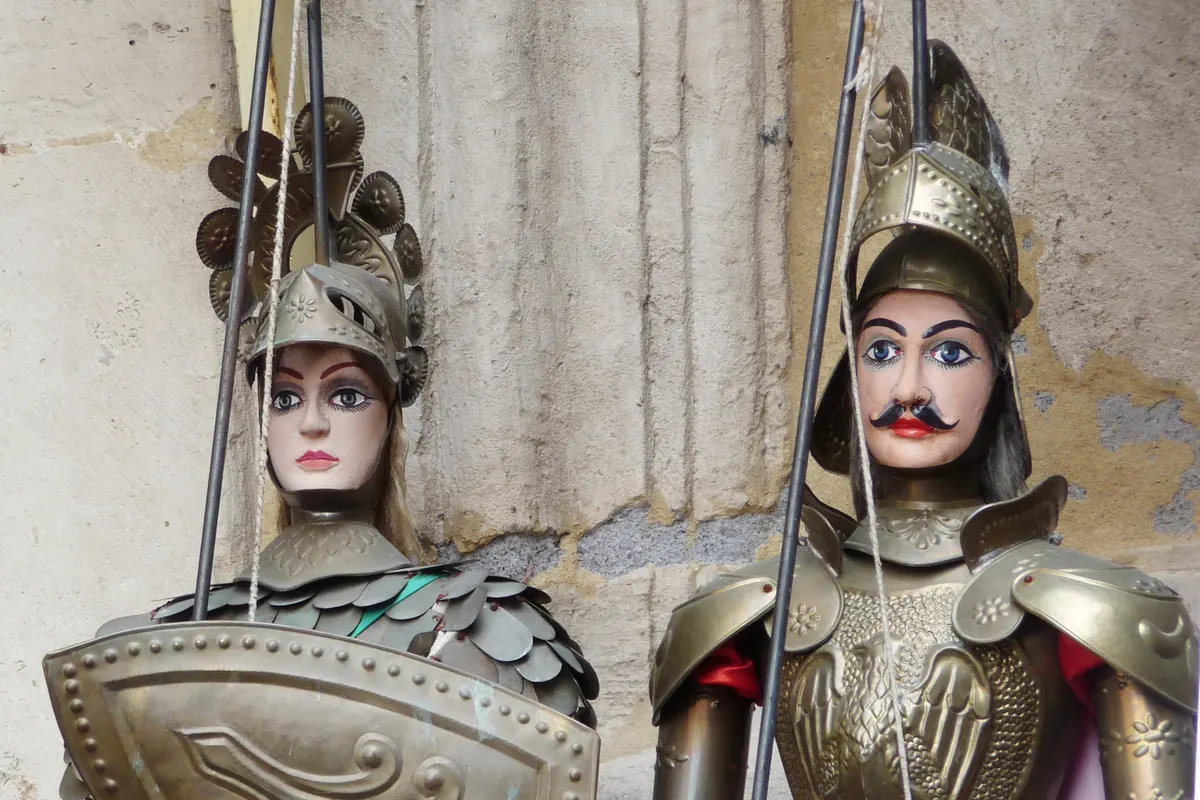
The Catania style is the tradition of eastern Sicily, including the provinces of Catania, Messina and Syracuse. Its puppets have padded frames that make them heavier, usually stand 110 to 130 cm tall and can reach about 30 kilos. Their legs do not bend, which lets the weight rest on the stage, and warriors usually hold the sword in the right hand. The handlers work from a raised bridge behind the backdrop, so the stage is wide but shallow, and speakers behind the scenes give the characters their voices.
Palermo and the west
In western Sicily the puppets are smaller, around 90 cm tall and 5 to 10 kilos. Their knees are jointed, and a wire through the right hand lets them draw and sheathe the sword. The puppeteers stand in the wings at the sides, on the same level as the puppets, which makes the stage deeper than it is wide. The master puppeteer directs the show, works the puppets and voices every character, female ones included, as well as making the sound and light effects.
Syracuse's own variant
Syracuse sits inside the eastern tradition but has its own twist. In the historic theatres of Syracuse, the puppets are similar to Catania's in size, weight, handling and repertoire, but their legs have a joint at the knee. Syracuse has a puppet theatre that stages the Opera dei Pupi, and the Italian Wikipedia entry for Ortigia places a small puppet theatre in the island's historic centre. It is a living art here, not only a museum piece.
Posters, music and the long cycle
Pupi companies advertised with painted posters called cartelli. In Catania they were painted in tempera on wrapping paper and showed the main scene of the evening's episode; Palermo's were split into squares, usually eight, each one an episode of the long cycle, with a sheet marked for that night's show. Music differs too: Catania once had a small orchestra with plucked strings, while recorded music is now common; in Palermo violins gave way to the barrel organ at the end of the nineteenth century.
Hard times and survival
The art has come close to vanishing more than once. Its decline was already noted at the end of the nineteenth century; cinema hurt it in the 1930s; and the economic boom of the 1950s and 1960s emptied the old neighbourhoods that filled the theatres. UNESCO calls the Opera dei Pupi the only example of an uninterrupted tradition of this kind of theatre, and in 2008 placed it on its list of humanity's living heritage.
Where to see the old puppets
If the show leaves you wanting more, Palermo's Antonio Pasqualino International Puppet Museum, founded in 1975, holds over 5,000 pieces from around the world and the largest and most complete collection of Palermo, Catania and Neapolitan pupi. Smaller collections are kept across Sicily. Seeing puppets of both schools side by side is the quickest way to understand how different they are.
Read next: Who's who among the paladins
Sources